Home | The origin of today's IALA A and IALA B system
The origin of today's IALA A and IALA B system
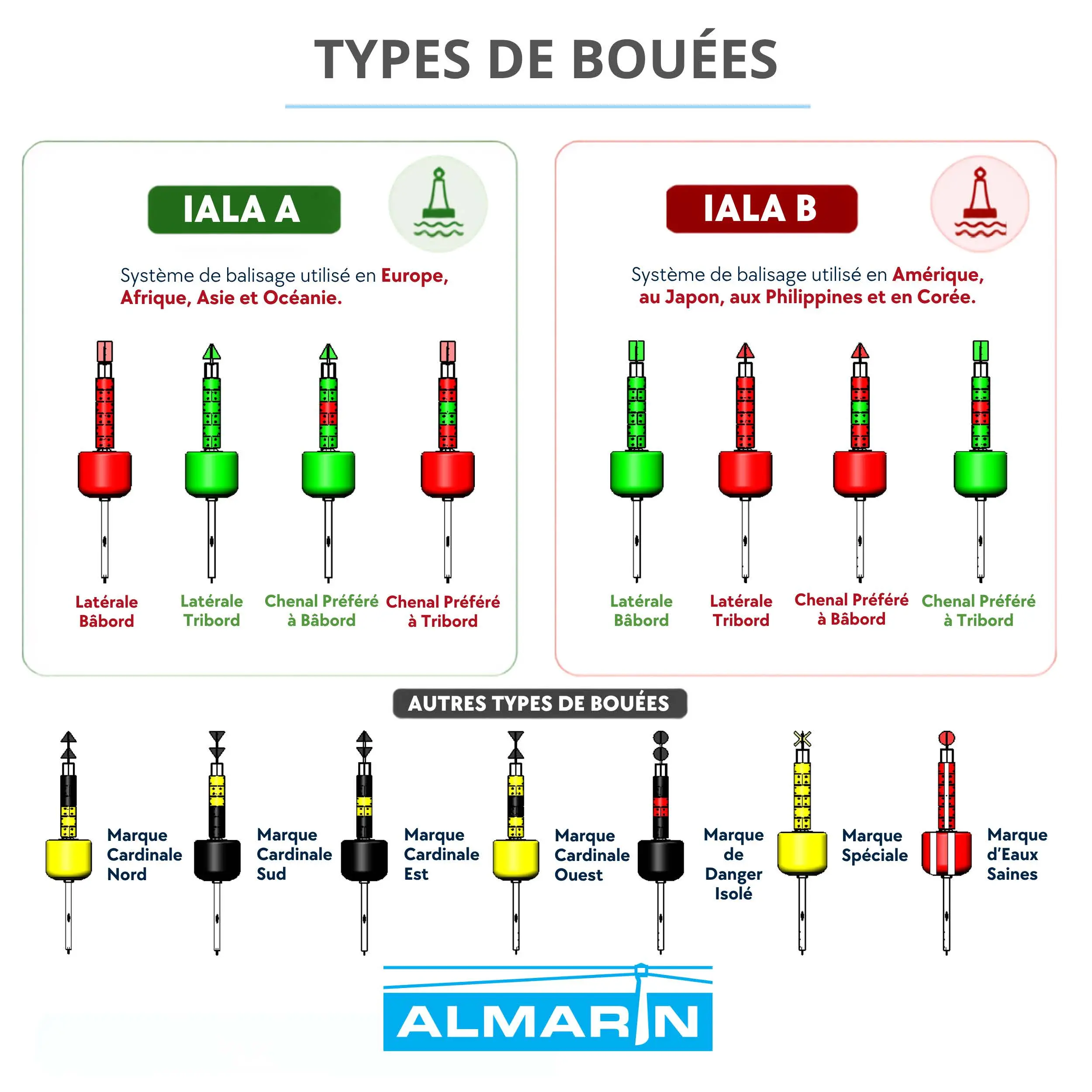
Why is port marked in red in one country and in green in another? It's not a coincidence, it's history.
Until the 1970s, more than 30 different buoyage systems coexisted around the world, with no common standard between countries. This lack of standardisation led, in 1971, to a chain of fatal accidents in the Dover Strait: several vessels, one after another, struck the same wreck, which had already been marked.
Following these accidents, IALA (International Organization for Marine Aids to Navigation) worked on a single, unified buoyage system for the whole world. But imposing a radical change on systems already established in each region wasn't feasible, so a compromise was reached: two regions, IALA A and IALA B, sharing the same cardinal marks, isolated danger marks, safe water marks and special marks, but with the colours of the lateral marks reversed between them.
On 15 April 1982, the agreement that made this system official was signed in Paris, joined by 53 nations, launching the worldwide harmonisation of buoyage that remains in place today:
- IALA A (Europe, Africa, Asia and Oceania): red to port, green to starboard.
- IALA B (the Americas, Japan, the Philippines and Korea): green to port, red to starboard.
At Almarin we are members of IALA, and we design and manufacture certified buoys for both systems.
>> Discover our full range of modular buoys and find the solution suited to your project here.